
Two of Swords Tarot Card Meaning
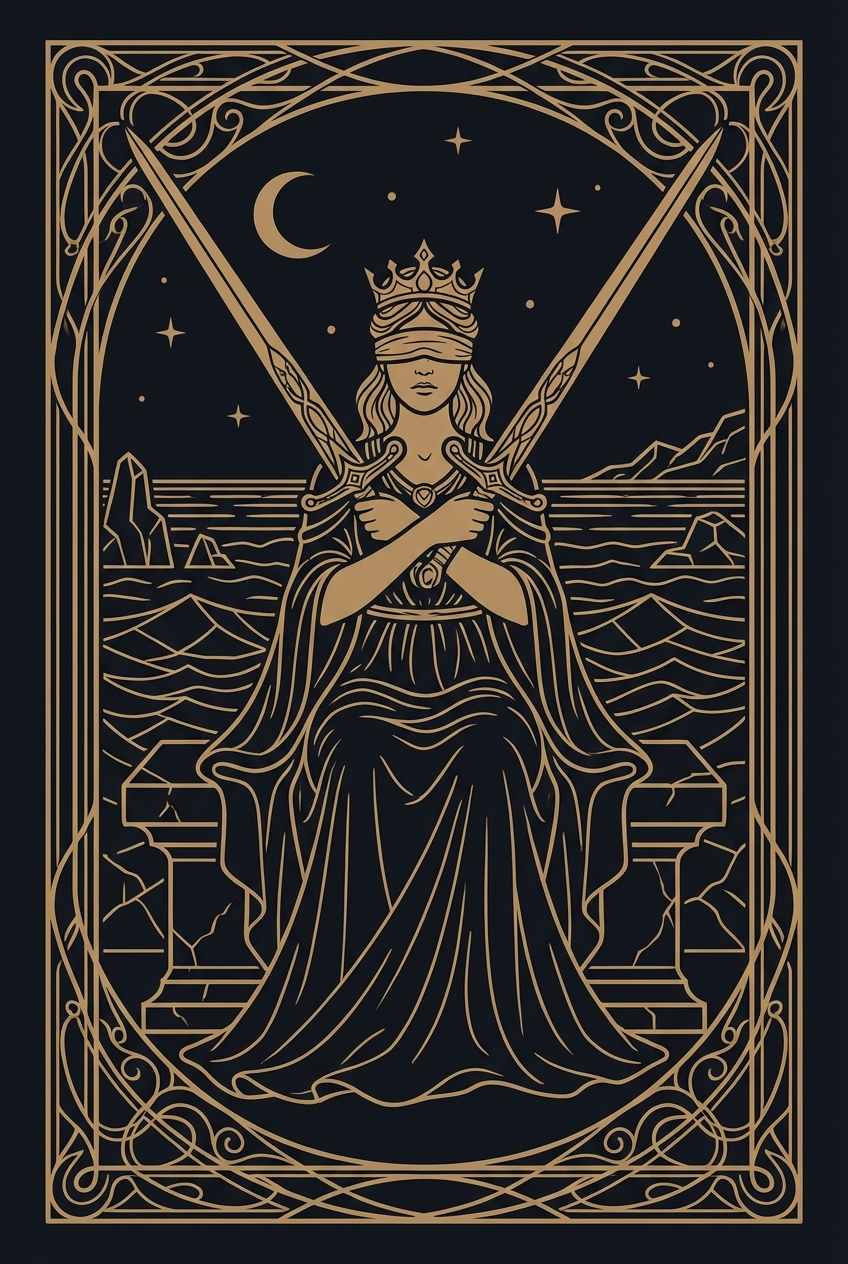
Pull the Two of Swords and you have drawn the card of the choice you keep walking around hoping it will choose itself. The Two of Swords is the second card of the Swords suit, representing deliberate stalemate, willful blindfolding, and the precise moment when not deciding has quietly become its own decision. In a reading, a blindfolded figure sits before a calm sea under a crescent moon, arms crossed over the chest, each hand gripping a sword held in perfect balance.
Whether you have drawn the Two of Swords in a love reading, career spread, or daily guidance pull, its meaning shifts depending on position and context. Below you will find the upright meaning, reversed interpretation, and specific guidance for love and career — everything you need to understand what the Two of Swords is telling you right now. For a personalized interpretation of the Two of Swords in your specific situation, try our free tarot reading tool.
Upright Meaning
Upright, the Two of Swords catches you mid-stall and asks whether the pause is wisdom or hiding. The Two of Swords, numbered II in the Swords suit, represents conscious indecision — the deliberate choice to sit with two options of comparable weight rather than grab the first one that relieves the tension. The blindfold is not imposed; it is chosen.
When this card appears, you are at a crossroads where both options carry weight and neither feels clearly superior. A relationship versus independence. One job offer versus another. Staying in a city versus starting fresh somewhere new. The Two of Swords does not rush you. It acknowledges that some decisions deserve the discomfort of sitting with uncertainty rather than the false relief of a snap call.
The blindfold carries an important nuance: it suggests you may be avoiding information that would make the choice easier. Not because the information is unavailable, but because receiving it would eliminate the comfort of indecision. Sometimes we prefer the limbo of not knowing to the responsibility of knowing. The Two of Swords gently asks whether your delay is wisdom or avoidance.
The calm sea behind the figure confirms that the situation is not urgent — there is no storm forcing your hand. But the crescent moon warns that this window of calm deliberation will not last forever. Eventually the tide will shift, and a decision unmade becomes a decision by default.
Use this pause wisely. Gather the information you have been avoiding. Consult someone whose perspective you trust but whose answer you fear. Then choose — not because you are certain, but because you are informed.
In Love Readings
In love, the Two of Swords shows up as the silence at the kitchen table that everyone agrees not to mention. The Two of Swords represents the relational stalemate where neither person will speak first and both call the quiet "peace" — the second card of the Swords suit showing what happens when two minds protect themselves into immobility.
You or your partner may be avoiding a conversation that both of you know needs to happen. The silence is not peaceful — it is loaded. Beneath the surface calm, unspoken feelings press against the blindfold, asking to be seen.
For singles, this card often appears when you are torn between two potential partners, or between pursuing love and protecting your independence. Neither option is wrong, but refusing to choose is creating its own kind of suffering. The Two of Swords invites you to remove the blindfold and look honestly at what each path offers.
For couples, this card signals a moment where compromise is needed but neither person wants to bend first. Stubbornness is masquerading as principle. The breakthrough comes when one of you sets down a sword — not surrendering, but signaling a willingness to engage rather than defend.
Want a personalized Two of Swords reading?
Discover what Two of Swords means for your unique situation with a personalized AI-powered tarot reading.
Get Your ReadingIn Career Readings
In a career spread, the Two of Swords is the pro-con list that has stopped helping. The Two of Swords stands for the professional decision where analysis has been exhausted without producing a clear winner — numbered II in the Swords suit, it names the moment when more spreadsheets will not save you, because the missing piece is information you have been quietly avoiding.
Two opportunities, two strategies, or two directions that each have legitimate merit. Spreadsheets and frameworks have run out of road. The card validates your paralysis — this is a hard call — while reminding you that more analysis alone will not resolve it.
If you are mediating between conflicting parties at work — two departments, two stakeholders, two visions — the Two of Swords asks you to facilitate honest dialogue rather than choosing sides prematurely. The best solution may synthesize elements of both positions.
For entrepreneurs weighing a pivot, this card counsels one more round of genuine information-gathering before committing. Talk to customers, not just advisors. The data you are missing is probably the data that breaks the tie.
Reversed Meaning
Reversed, the Two of Swords is a blindfold yanked off mid-thought. The reversed Two of Swords — second card of the Swords suit inverted — represents the end of comfortable avoidance, the moment information you were not ready for arrives anyway, or pressure forces a choice before you feel sovereign enough to make it. The stalemate breaks, but rarely on your timeline.
Information you have been avoiding reaches you anyway: a truth about a relationship, a reality about your career, a fact about yourself that you were not ready to face. Ready or not, clarity has arrived.
This reversal can also indicate a decision made under duress. External pressure forces your hand before you feel prepared, and the choice feels more like surrender than sovereignty. While the outcome may not be ideal, there is relief in motion after prolonged paralysis.
In some cases, the Two of Swords reversed signals information overload. Too many opinions, too much data, and conflicting advice have made the decision harder rather than easier. The remedy is to silence the noise and return to your own judgment. Others can inform your decision, but only you can make it.
Whatever form this reversal takes, it marks the end of avoidance. The comfortable numbness of indecision is dissolving, and while the transition may feel destabilizing, it is ultimately necessary. You cannot build a life on the fence.
Two of Swords: Yes or No?
Upright
Maybe
The Two of Swords (upright) says maybe. With the energy of indecision, the answer is not clear-cut. More information or patience may be needed before the path becomes clear.
Reversed
Maybe
The Two of Swords (reversed) says maybe. With the energy of indecision, the answer is not clear-cut. More information or patience may be needed before the path becomes clear.
Want a more detailed answer? Try the free Yes or No Tarot tool for a personalized one-card draw.
常見問題
- What does the Two of Swords mean in a yes or no reading?
- The Two of Swords is a "not yet" in yes or no readings. It indicates that the situation is unresolved and more information is needed before a clear answer can emerge. This is not a permanent "no" — it is a counsel to pause, gather missing data, and revisit the question when you have greater clarity.
- Does the Two of Swords mean someone is lying?
- Not necessarily lying, but potentially withholding. The Two of Swords often indicates that someone — possibly you — is avoiding a difficult truth rather than actively deceiving. The blindfold represents chosen avoidance, not malice. The card invites honest communication to break the impasse.
- How does the Two of Swords differ from the Two of Wands?
- The Two of Swords represents a difficult choice where neither option feels clearly right, often accompanied by emotional avoidance. The Two of Wands represents planning and vision — you have already made a decision and are now surveying the path ahead. Swords is about the paralysis before choosing; Wands is about the excitement after choosing.
塔羅解讀僅供娛樂與自我反思參考,不能替代人生重要決策中的專業建議。請始終保留自己的判斷,並在需要時尋求合格專業人士的協助。